
Things “Prompt Pushers” Thought They Understood About DAWs – But Are Completely, Utterly Wrong About

Every now and then, especially in groups where “AI-generated music” is the hot topic, I encounter a parade of self-declared “AI creators” who seem absolutely convinced they understand how AI, DAWs, plugins, audio engines and production workflows operate.
Spoiler: they don’t. Not even close.
The latest example – my personal favorite – came from an exchange with a couple of AI-wannabe musicians who tried to argue that a DAW is a type of AI. Yes. A Digital Audio Workstation. According to them, pressing Record apparently counts as machine intelligence now.

This is the level we’re dealing with – usually among Suno-wannabes and so-called Udio-idiots when we try to explain how DAWs works.
A DAW IS NOT AI – IT WILL NEVER BE AI!
A DAW is a workstation – software used to record, edit and produce audio, not a “thinking” system (see any basic DAW definition). A timeline. A mixer. A routing environment.
It doesn’t think. It doesn’t predict. It doesn’t learn. It doesn’t hallucinate answers because you ask stupid questions. It doesn’t care what you want. It does exactly what you tell it to do.
AI, meanwhile, is defined by its capacity to generate, classify, predict or reason based on trained data – a machine based system that infers from input to generate outputs like predictions, content or decisions (see the OECD and EU definitions of AI systems). That is machine learning, which is something completely different from a sequencer that has existed since the 1980s.
But apparently, for some people on the internet, everything becomes AI if you squint hard enough.
That ALSO includes the Google screenshot that was used to prove me wrong saying “Yes, DAWs use AI in a variety of ways to enhance music production”.
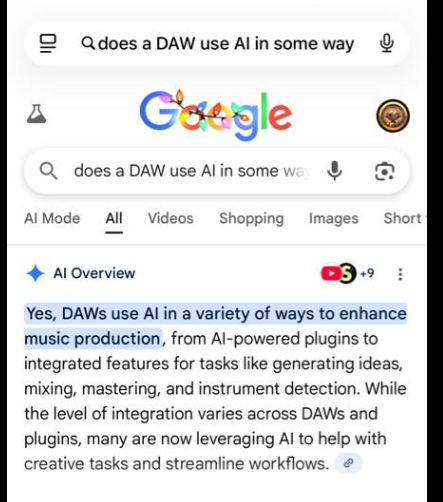
The text used is not a technical definition, it is an AI generated summary from Google’s experimental AI Overviews and AI Mode in Search feature, which stitches together a generic answer to the vague prompt “does a DAW use AI in some way”... That “AI researcher” is by the way extremely unreliable as it very much works as ChatGPT in “quick response mode” and guessing (since users tend to hate wait for a correct answer) what it cannot cover by itself (unless you use Thinking mode).
It talks about using AI powered plugins and features inside a DAW, not about the DAW itself magically becoming an AI system. Google itself describes these AI Overviews as AI generated “snapshots” that simply bundle key information with links to real sources, not as authoritative definitions of anything (see their own description). Treating that blurb as proof that “a DAW is AI” is like treating an ad banner as peer reviewed research.
“But VSTs Use AI!”
Yes, some do – and that still doesn’t make your DAW AI!
This was the next brilliant argument thrown at me:
“Most of the components in a DAW use AI. Are you slow?”
First: No, they don’t.
Second: Calling people slow and other random words doesn’t magically make your argument correct.
Most plugins run on traditional DSP – decades-old mathematics based on manipulating digital samples, not on “learning” from data (audio DSP is literally just signal processing code, not AI). Compression, EQ, filtering, reverb, synthesis, modulation – none of that is AI. If you think a compressor is artificial intelligence, you need to revisit the basics.
Some plugins do use machine learning for tasks like noise reduction or stem separation – for example real time denoisers trained on speech like VoiceGate or deep learning based noise reduction projects like DeepFilterNet. Fine. But your environment does not become AI just because a plugin inside it happens to use it. Your microwave doesn’t become AI if you heat a smart thermometer inside it either.
The Real Issue: AI Musicians Who Don’t Understand Music Tools
This whole conversation acutally exposed something deeper, which makes this topic interesting, and that is why I choose to highlight the idiocrazy: Many AI-first creators cannot explain – or even identify – the tools they’re supposedly replacing. There’s a growing crowd of prompt-pushers who:
- have never mixed a track manually,
- never aligned vocals without an AI tool,
- never programmed automation by hand,
- never learned gain staging,
- never rendered or layered anything intentionally,
- and absolutely never used a DAW beyond dragging stems into the timeline.
Yet they lecture others on “how audio production really works”.
And when someone challenges their nonsense, they fire off buzzwords like:
- “you refuse to be educated”
- “you’re a luddite”
- “DAWs used AI for decades!”
- “it’s the same thing!”
No. It’s not. And calling someone a luddite doesn’t turn confusion into expertise. It just telegraphs desperation.
Why This Matters
The problem isn’t people using AI.
The problem is people pretending that AI makes them instant audio engineers – and then attacking anyone who points out the difference between a tool and a technology.
AI is powerful. It’s useful – but it doesn’t replace understanding.
If you think a DAW is artificial intelligence, you’re not an innovator. You’re not “ahead of the curve”.
You’re not misunderstood.
You’re just wrong. And loudly so.
If you want to be taken seriously as a creator in this hybrid world of AI-assisted music:
- Learn what your tools are.
- Learn what your tools are not.
- Stop claiming everything with buttons and soundwaves is AI.
Because right now, the biggest challenge for AI-powered music isn’t the tech. It’s the users who don’t understand it.
Discover more from Tornevalls
Subscribe to get the latest posts sent to your email.

